Faith & Politics: Tracking Evangelical and Conservative Affiliation in the United States from 2014 to 2024
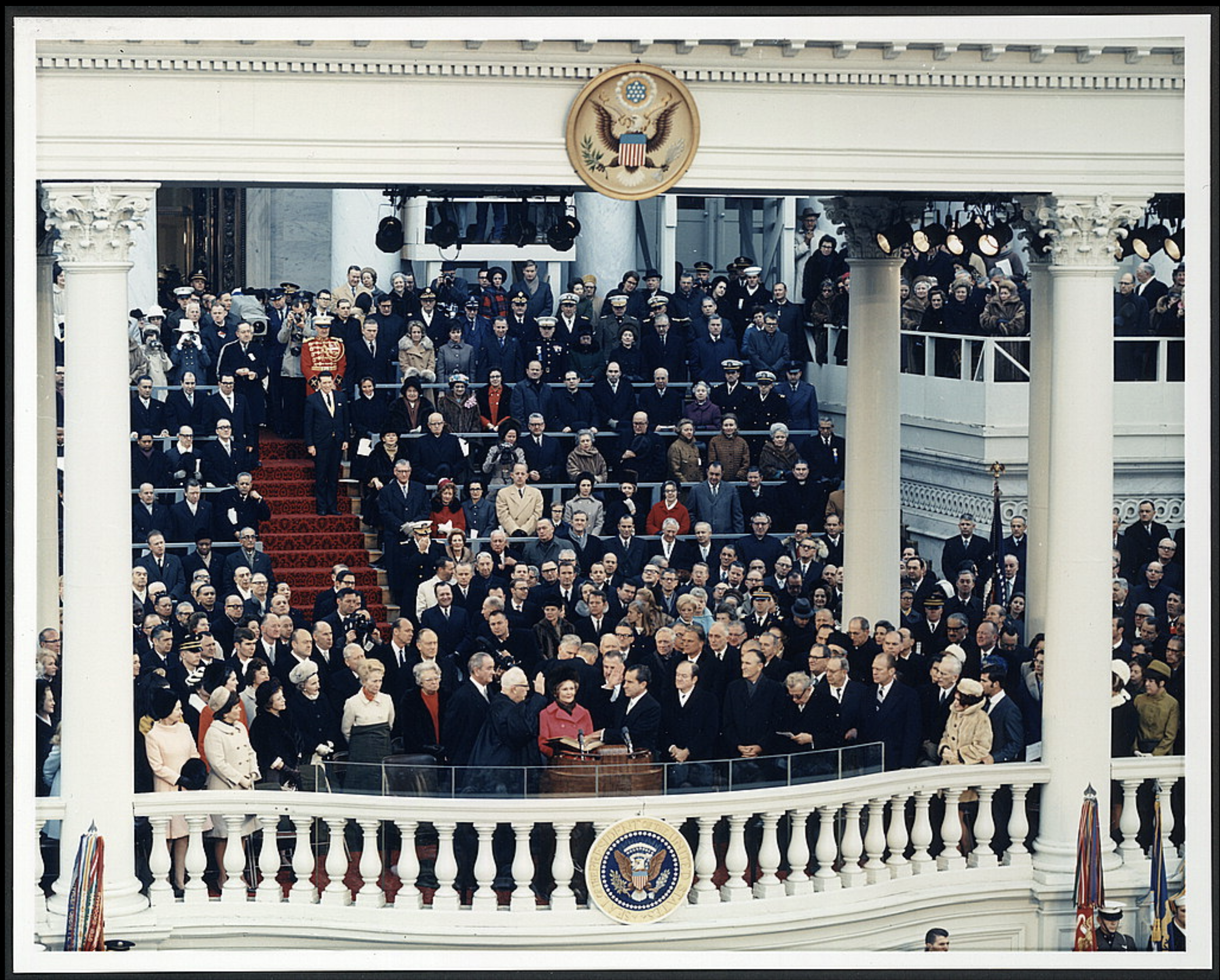
Chief Justice Earl Warren administering the oath of office to Richard M. Nixon on the east portico of the U.S. Capitol, January 20, 1969
Library of C0ngress
In 1973, Republican political organizers used the issue of abortion and the United States Supreme Court's Roe v. Wade decision to mobilize evangelicals into a unified right-to-life movement. Evangelical leaders at the time emphasized a belief that society was declining, a worldview that contributed to skepticism toward civil rights, anti-poverty efforts, and other social reforms.
As Byrd and Hudnut-Beumler describe, the Moral Majority framed issues such as abortion, feminism, LGBTQ rights, and the Equal Rights Amendment as threats to the traditional American family (p. 349). In 2025, it seems as though history is repeating itself. "Conservative evangelical Christians have become more reliably identified with the Republican Party, even to the extent of supporting Donald J. Trump, the most morally flawed candidate in contemporary American politics, for president in 2016 and again in 2020." (Byrd & Hudnut-Beumler, pg. 366). This study uses statistical methods such as Kendall's Tau and ordinal logistic regression to examine whether evangelical identification and political conservatism have increased and are linked since 2014, the years leading up to Trump’s first presidential campaign.
Is there a relationship between Evangelical Christian identification and political conservatism in the United States, and have both increased since 2014 to 2024?
H0: There is no association between identifying as an Evangelical Christian and identifying as politically conservative in the United States.
H01: There has been no increase in Evangelical Christian identification or in political conservatism in the United States since 2014.
Ha: There is an association between Evangelical Christian identification and political conservatism.
Ha1: There has been an increase in Evangelical Christian identification and/or political conservatism since 2014.
Tools Used:
General Social Survey → data
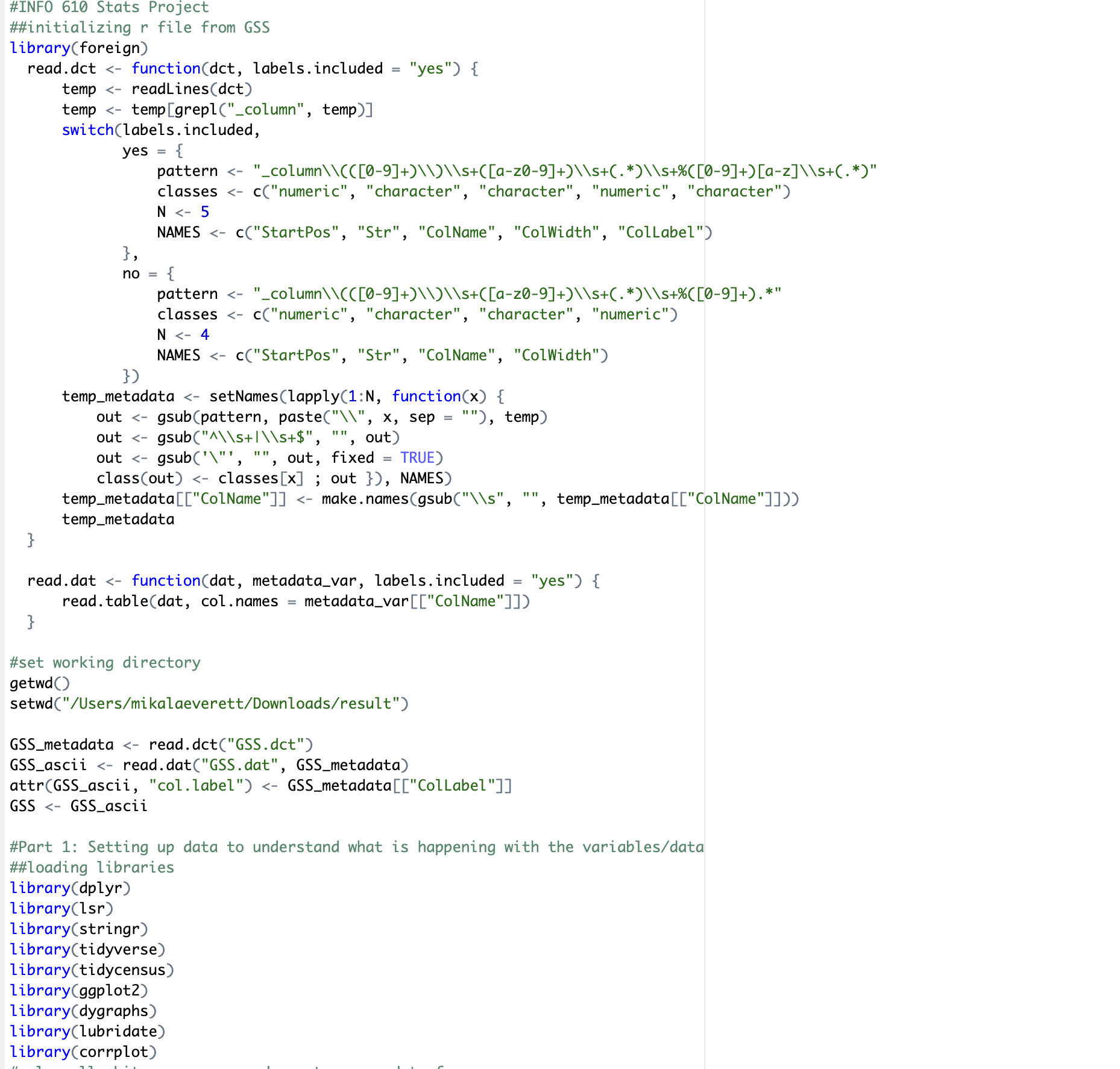
R → data manipulation, cleaning and modeling
Adobe Express → poster creation
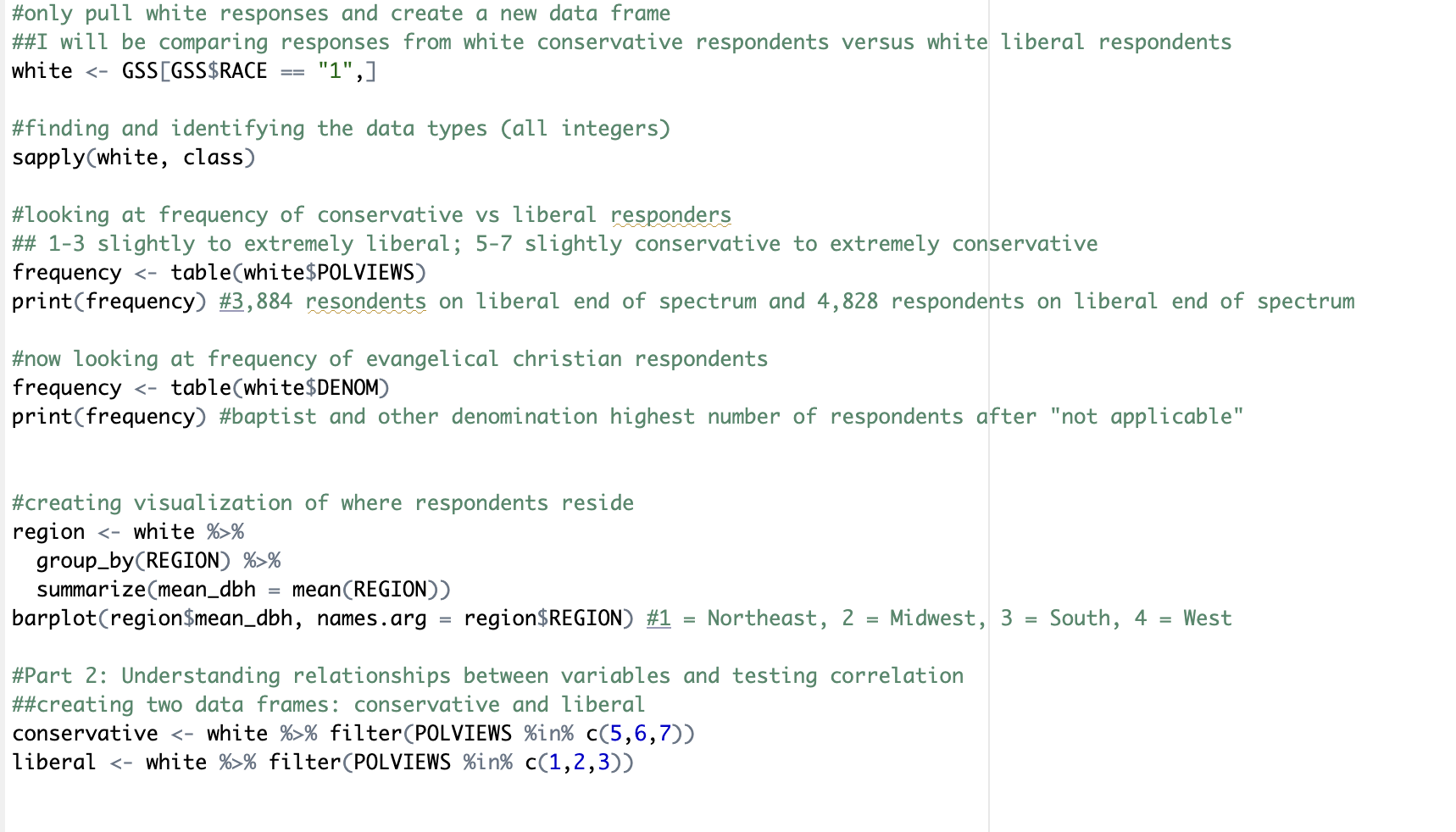
The data from GSS was restricted to a sample of respondents who identified as White to align with the literature review on the history of Evangelicals in the United States.
Limiting the sample to White respondents (GSS Race = 1), ideological self-placement is split with 3,844 respondents identifying as liberal and 4,828 identifying as conservative.
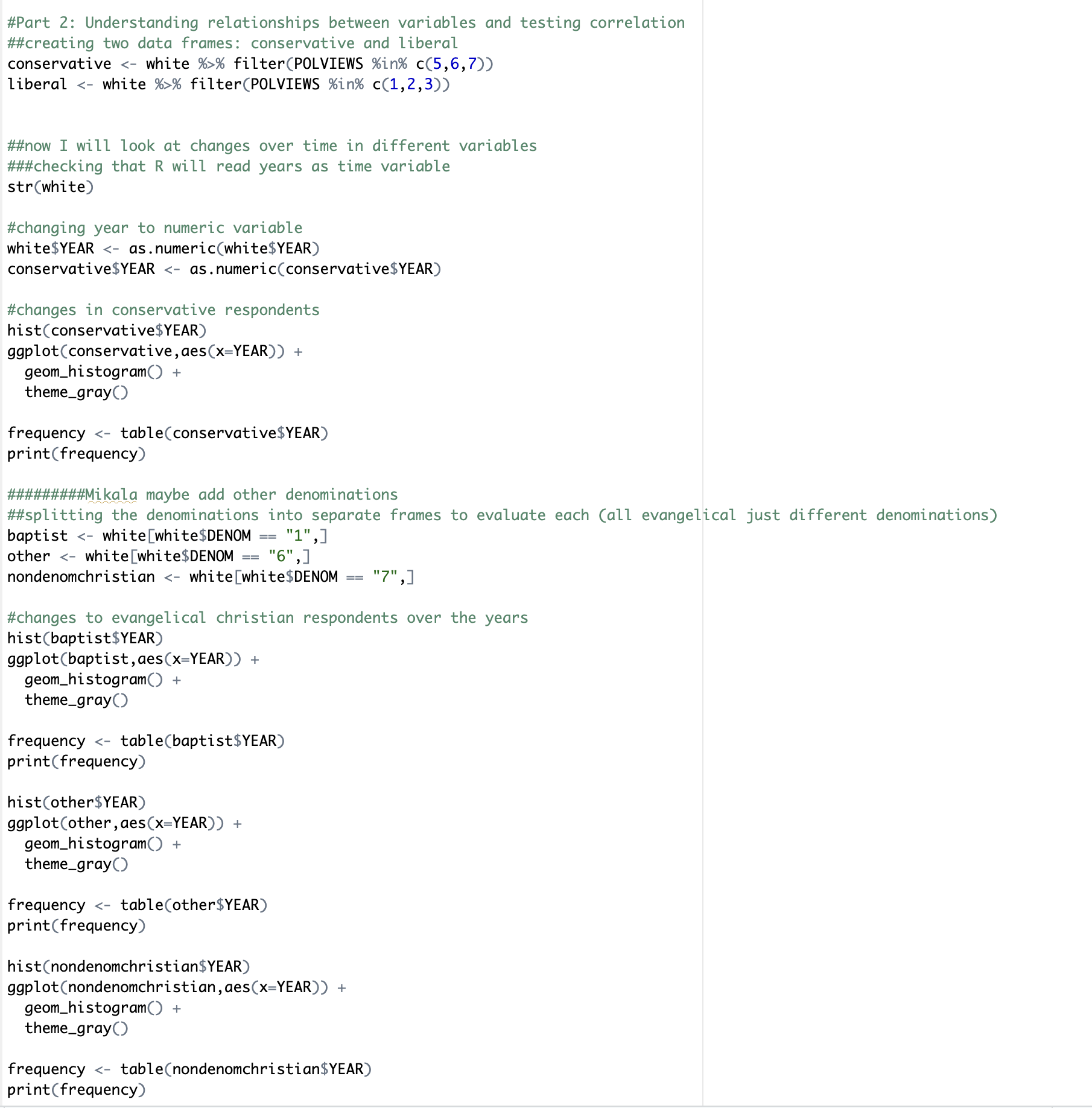
The most common Christian identifiers in the dataset were Baptist, Methodist, Espicopal, Other Denomination, and Non-Denominational. These categories were used to define the “evangelical” indicator in subsequent models and tests.
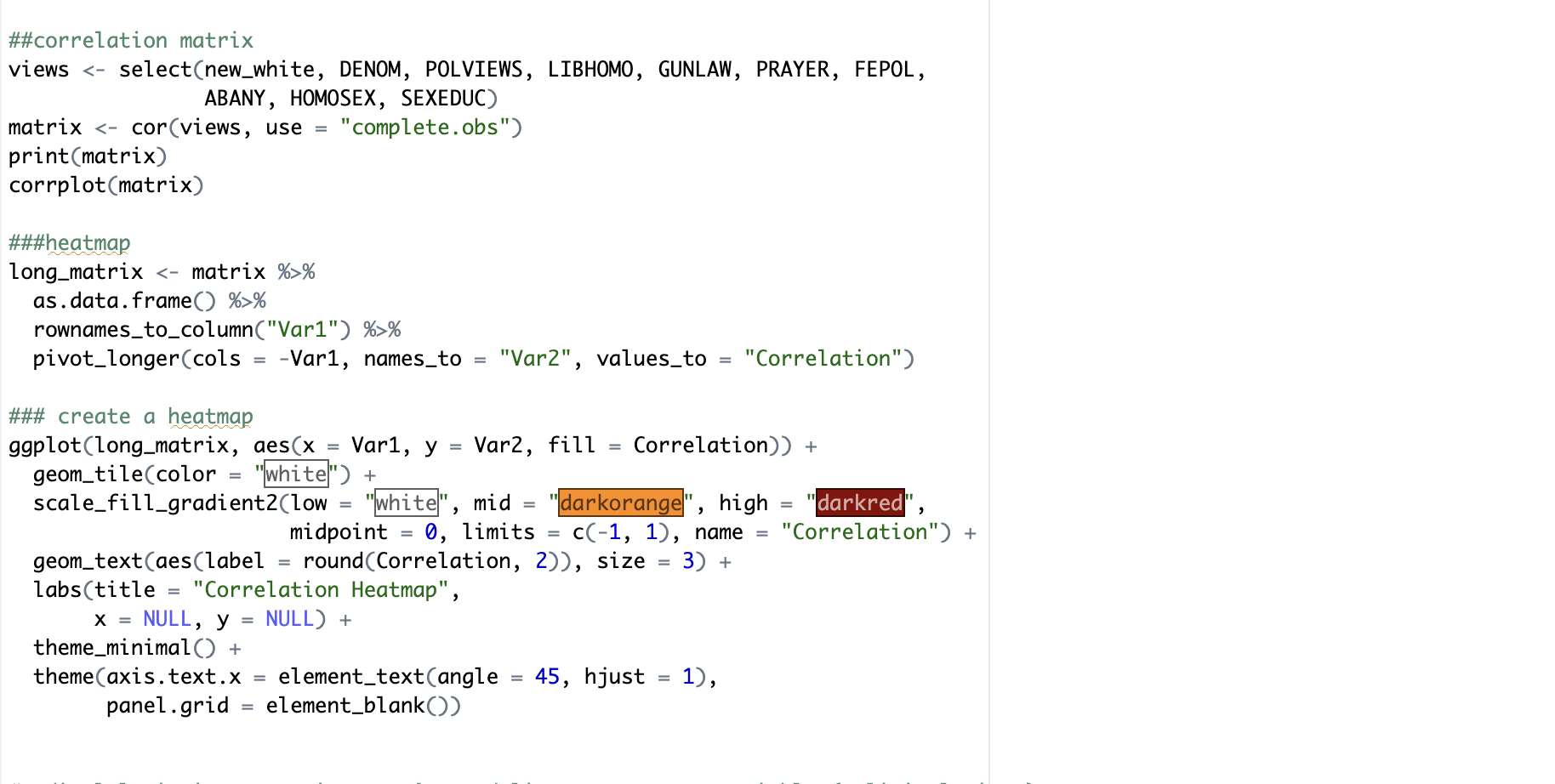
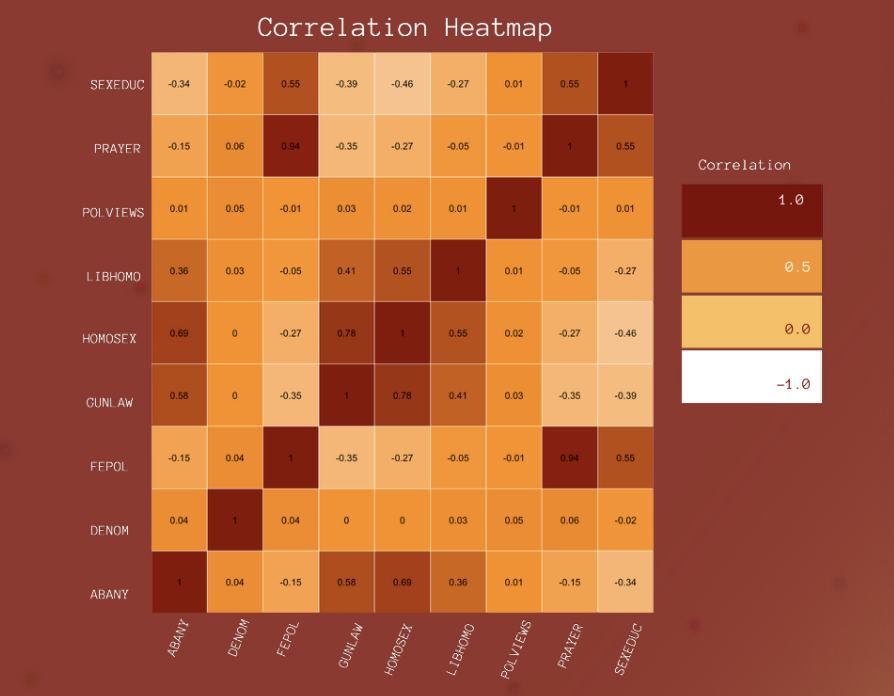
Political conservatism was measured using POLVIEWS (7-category ideological scale) variable. Issue variables included abortion (ABANY), gun control (GUNLAW), prayer in schools (PRAYER), attitudes toward homosexuality (HOMOSEX), women in politics (FEPOL), and (SEXEDUC).
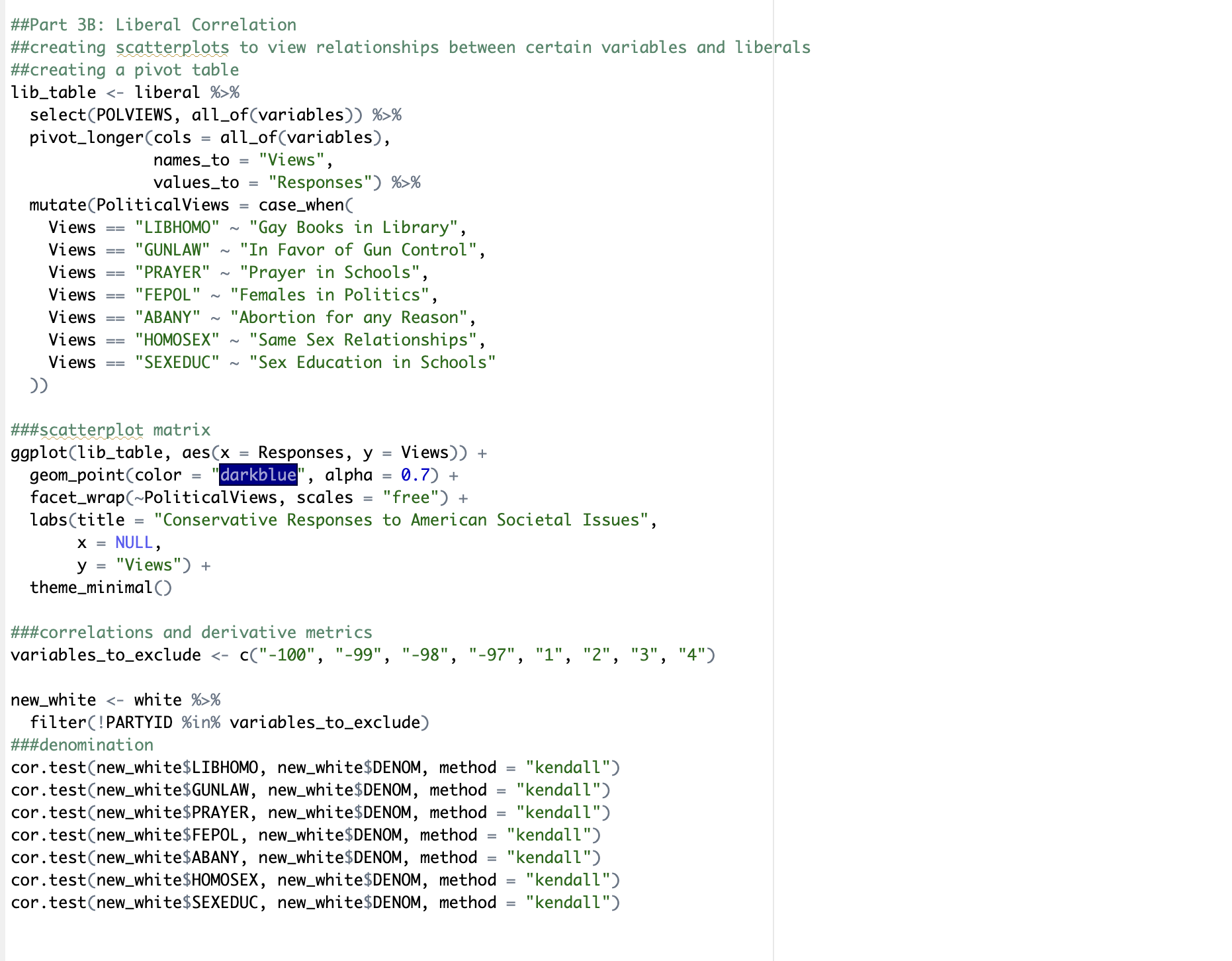
Kendall’s tau correlations tested bivariate associations betweeen denomination and attitudes toward social ussues.
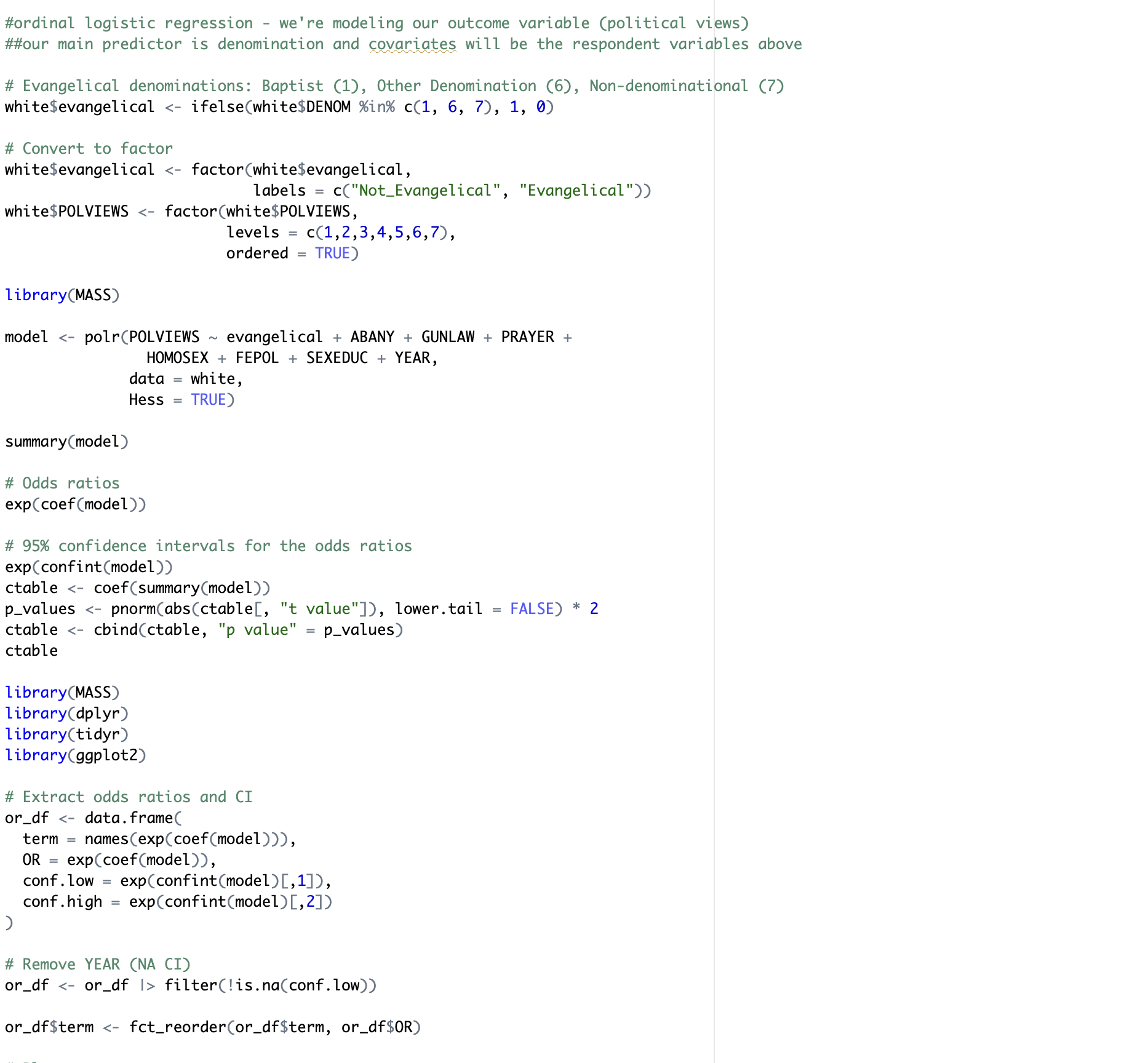
To analyze ideological placement while controlling for multiple predictors, an ordinal logistic regression (polr) was estimated with POLVIEWS as the outcome and evangelical identity, issue attitudes and YEAR as predictors. The YEAR coefficient was used to evaluate change over time in political conservatism. Observations with invalid codes (-97 to -100) were removed for all tests.
Correlation tests using Kendall's Tau revealed that religious denomination is modestly statistically significant with several political/social issue attitudes.
Significant associations (p < 0.5):
• Gun Control
• Prayer in Schools
• Women in Politics
• Abortion for any reason
• Attitudes toward same-sex relationships
• Sex education
Although several correlations reach statistical signficance, effect sizes are small, indicating that denomination alone explains only modest variation in social issue attitudes.
An ordinal logistic regression model was used to assess whether evangelical identity and specific issue positions predict ideology while controlling for year and attitudes.
Key Predictors:
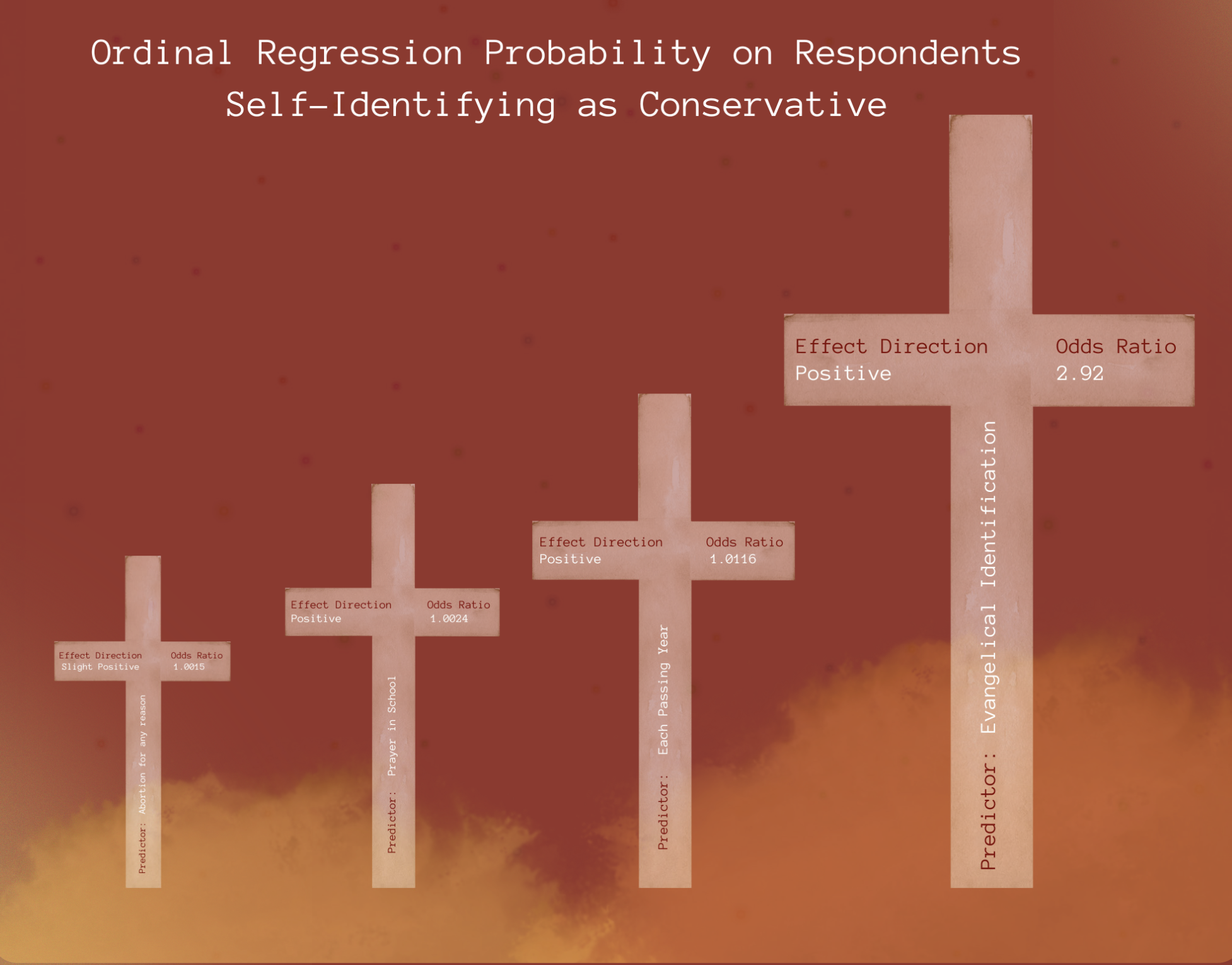
Evangelical Identity - Being evangelical nearly triples the odds of associating with conservative ideology. This the largest and most statistically meaningful effect in the model.
Attitudes on Social Issues - For variables such as Prayer in Schools (PRAYER), more conservative responses show slightly higher conservatism while for views on Same-Sex relations (HOMOSEX), more accepting attitudes show slightly lower conservatism. Once Evangelical identity is included in the model, many of the issue-based predictors lose statistical significance.
Time - Each year is associated with a ~1.2% increase in odds of conservative identification. There is a modest upward trend in conservatism across the sampled years.
Evangelical identity is the strongest predictor of conservative ideology, even after controlling for a wide range of attitudes on social issues and year. Positions on issues matter, but their effects are small relative to the influence of evangelical identity. The positive YEAR effect suggests that conservatism has increased slightly over time within the sample.
References:
Byrd, James P., and James Hudnut-Beumler. The Story of Religion in America: An Introduction. First, Westminster John Knox Press.
• Gregory A. Smith, et al. Decline of Christianity in the U.S. Has Slowed, May Have Leveled Off. Pew Research Center, 26 Feb. 2025,
• Pearce, Lisa D., and Claire Chipman Gilliland. Religion in America. University of California Press, 2020.
• Davern, Michael; Bautista, Rene; Freese, Jeremy; Herd, Pamela; and Morgan, Stephen L.; General Social Survey 1972-2024. [Machine-readable data file]. Principal Investigator, Michael Davern; Co-Principal Investigators, Rene Bautista, Jeremy Freese, Pamela Herd, and Stephen L. Morgan. Sponsored by National Science Foundation. NORC ed. Chicago: NORC, 2025: NORC, 2025: NORC at the University of Chicago [producer and distributor]. Data accessed from the GSS Data Explorer website at gssdataexplorer.norc.org.
Github
Key Takeaways:
Null Hypothesis 1: Rejected. The ordinal logistic regression shows that identifying as evangelical is a strong predictor of political conservatism. This indicates a robust link between evangelical identity and conservative self-placement.
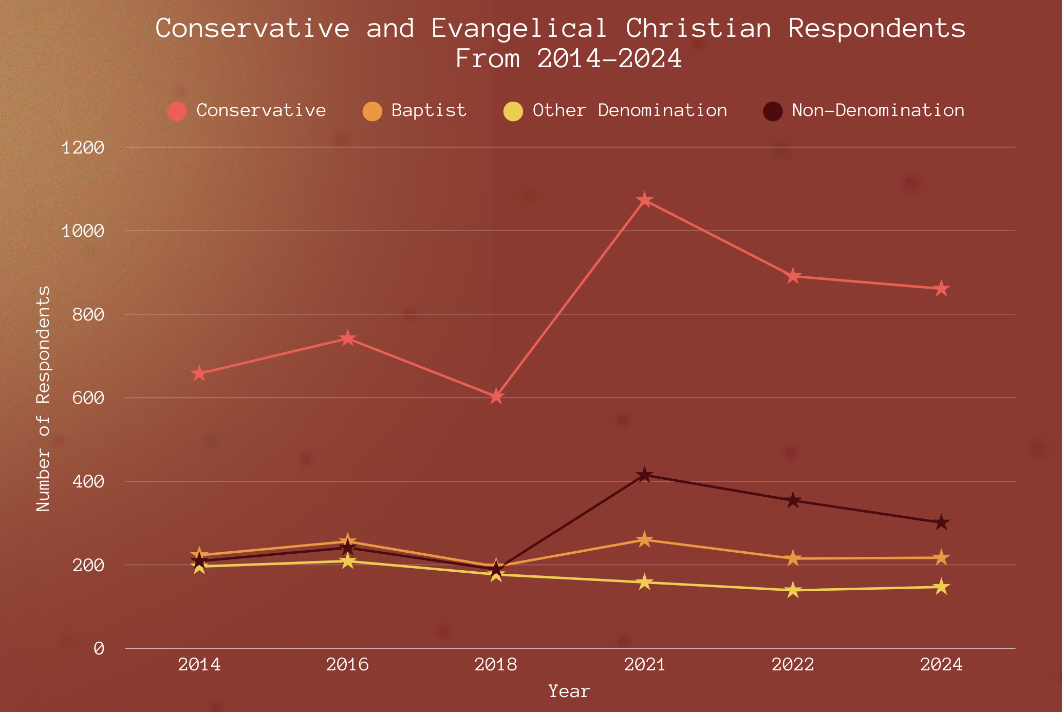
Null Hypothesis 2: Partially Rejected. The regression results show a small but statistically significant year-over-year increase in conservative self-identification. This suggests a gradual upward trend in political conservatism in the GSS sample. However, the descriptive patterns suggest that there is not a consistent increase in respondents who identify as Evangelical Christian across all denominations.
Limitations:
Measurement of "Evangelical": The evangelical category was constructed using denomination labels. This is an approximation and may have misclassified some respondents.
Restricted sample: The analysis was limited to White respondents for consistency. Results may change when considering other racial and ethnic groups.